

EMS Energy Management System
Help enterprises build zero-carbon factories, achieve precise energy management, and reduce energy costs.
Product Details
EMS Energy Management Platform
One-sentence positioning
The EMS Energy Management System is a digital platform for manufacturing enterprises that monitors and optimizes all energy media—including electricity, water, gas, steam, and compressed air. It follows a core workflow of data collection, monitoring and analysis, optimization control, and closed-loop management. Every kilowatt-hour, ton of water, and cubic meter of gas is traceable, analyzable, and actionable.
I. Why Manufacturing Companies Need EMS
Manufacturing enterprises commonly face four types of energy management issues:
Issue | Performance |
|---|---|
Hard to read | Energy data is scattered across meters, manual readings, and reports from various workshops, lacking a unified standard. |
Inaccurate | Manual Excel-based consolidation of unit consumption and energy cost calculations leads to inconsistent metrics and delayed reporting. |
Uncontrollable | Hard-to-detect equipment idling, standby power consumption, and leaks; relying on manual inspections to identify anomalies. |
false | Energy consumption accountability cannot be assigned to workshops, production lines, or equipment, leaving energy efficiency upgrades without data support. |
The EMS positioning is to shift energy consumption management from post-event reconciliation to real-time visibility, process control, and outcome accountability.
II. Product Overview
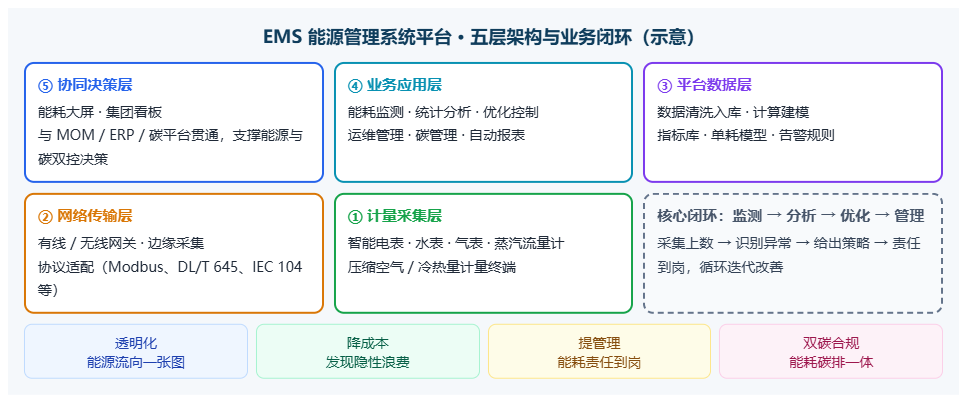
The platform adopts a layered architecture covering the full chain from metering terminals to management decision-making: The Collection Layer handles data ingestion and cleansing for various energy metering sources; the Platform Layer manages data storage, computation, and modeling; the Application Layer delivers scenario-based capabilities including monitoring, analysis, optimization, operations & maintenance, and reporting; and the Collaboration Layer integrates with MOM, ERP, carbon management platforms, and other systems to support enterprise-level dual control of energy and carbon.
3. Core Features
1. Energy Monitoring (Visibility)
Multi-energy metering: Unified integration of electricity, water, natural gas, steam, compressed air, heating/cooling energy, and more.
Real-time and near-real-time monitoring of voltage, current, power, flow rate, temperature, pressure, and other parameters.
Energy Dashboard & Multi-dimensional Analytics: Drill down by plant, workshop, production line, equipment, and shift.
2. Statistical Analysis (Clear Insights)
Energy consumption statistics by time, category, and product: peak-valley electricity usage, unit consumption, and energy cost accounting
Year-over-Year, Month-over-Month, and Benchmark Analysis: Compare against your own historical data and industry leaders.
Automated Reports: Daily, weekly, monthly, and annual reports generated automatically to replace manual consolidation.
3. Optimized Control (Under Control)
Anomaly Detection for Energy Usage: Automatic alerts for issues like equipment idling, standby mode, over-limit usage, and leaks.
Demand Management: Peak Load Monitoring and Alerts to Support Peak Shaving and Valley Filling Decisions
Energy-saving strategy support: Provide optimization recommendations for equipment start/stop and process parameters based on operational data.
4. Operations Management (Verified Facts)
Metering instrument ledger with online calibration reminders to prevent inaccurate readings.
Alert severity levels integrated with ticket workflows for closed-loop anomaly resolution
Assign energy consumption responsibility to workshops or production lines and include it in performance evaluations.
5. Carbon Management Extension (Dual-Carbon Ready)
Conversion and accounting of energy consumption data to carbon emission data (aligned with national accounting guidelines)
Carbon emission ledger, carbon intensity metrics, and carbon reduction project tracking to provide the data foundation for carbon trading and disclosure.
IV. System Architecture
The architecture is divided into five layers from bottom to top (see attached figure):Metering and Collection Layer → Network Transmission Layer → Platform Data Layer → Business Application Layer → Collaborative Decision-Making LayerAt its core, it's a closed-loop data chain: Monitor → Analyze → Optimize → Manage.
V. Core Value
Value Direction | Description |
|---|---|
Transparency | One-page view of plant-wide energy flow: no losses or waste can hide. |
Reduce costs | Identify hidden waste such as idling, standby power, and over-limit usage to support energy-saving retrofit projects (actual savings depend on enterprise baseline measurements). |
Manage | Assign energy responsibility to workshops and equipment, with data-driven assessments and improvements. |
Dual Carbon Compliance | Integrated calculation of energy consumption and carbon emissions to support carbon disclosure, carbon trading, and green factory certification. |
VI. Typical Application Scenarios
High-Energy Consumption Workshops/Production Lines: Sub-metering of Electricity, Gas, and Steam; Single-Unit Consumption Control
Air Compressor Station, Chiller Station, and Other Utility Systems: Operational Efficiency Monitoring and Optimization
Peak-Valley Electricity Management: Production Scheduling and Demand Coordination (Integrates with APS/MOM)
Multi-plant Group: Centralized Energy Data Collection and Cross-site Benchmarking
7. Implementation Roadmap (Phased Approach Recommended)
Phase 1 (Foundation)Metering coverage for key energy-consuming points + data integration + dashboard and reporting launch
Phase 2 (see results): Anomaly Alerts, Itemized Statistics, Responsibility Assessment, Energy Saving Analysis
Phase III (Stepping Up)Integration with MOM/APS for optimization, carbon management, and AI-driven energy-saving strategies
Note: The benefits described are directional. Actual energy savings and payback periods must be determined based on real-world baseline data from your enterprise. Carbon emission calculations shall follow the latest national guidelines.