
AI Digital Employee Platform
Bring AI into frontline operations as "Digital Employees." The platform provides capabilities, the team ensures execution, and operations deliver value. The AI Digital Employee Platform is an enterprise-grade agent application built on WorkBuddy, Doubao Work, or DeepSeek Harness. It features a three-layer architecture: Foundation + Role + Operations. This structure incubates digital employee roles across business scenarios while connecting seamlessly with enterprise systems and data assets. Our FDE implementation teams embed directly in business units to support every stage—from scenario discovery and design evaluation to pilot deployment and operational iteration. We ensure AI integrates into real workflows to continuously generate measurable business value.
Product Details
SuperAgent Enterprise AI Digital Employee Platform: 6 Key Highlights
Unified foundation, rapid developmentLeverage WorkBuddy / Doubao Work's native capabilities (LLMs, agent orchestration, workflow engine, enterprise knowledge base, system connectors). Digital employees are ready to deploy out of the box—no need to reinvent the wheel.
Scenario-driven, targeting pain pointsThe FDE team maps out scenarios involving repetitive tasks, cross-system break points, and experience dependencies by going deep into the front lines. We focus only on high-value, actionable scenarios—not demo features.
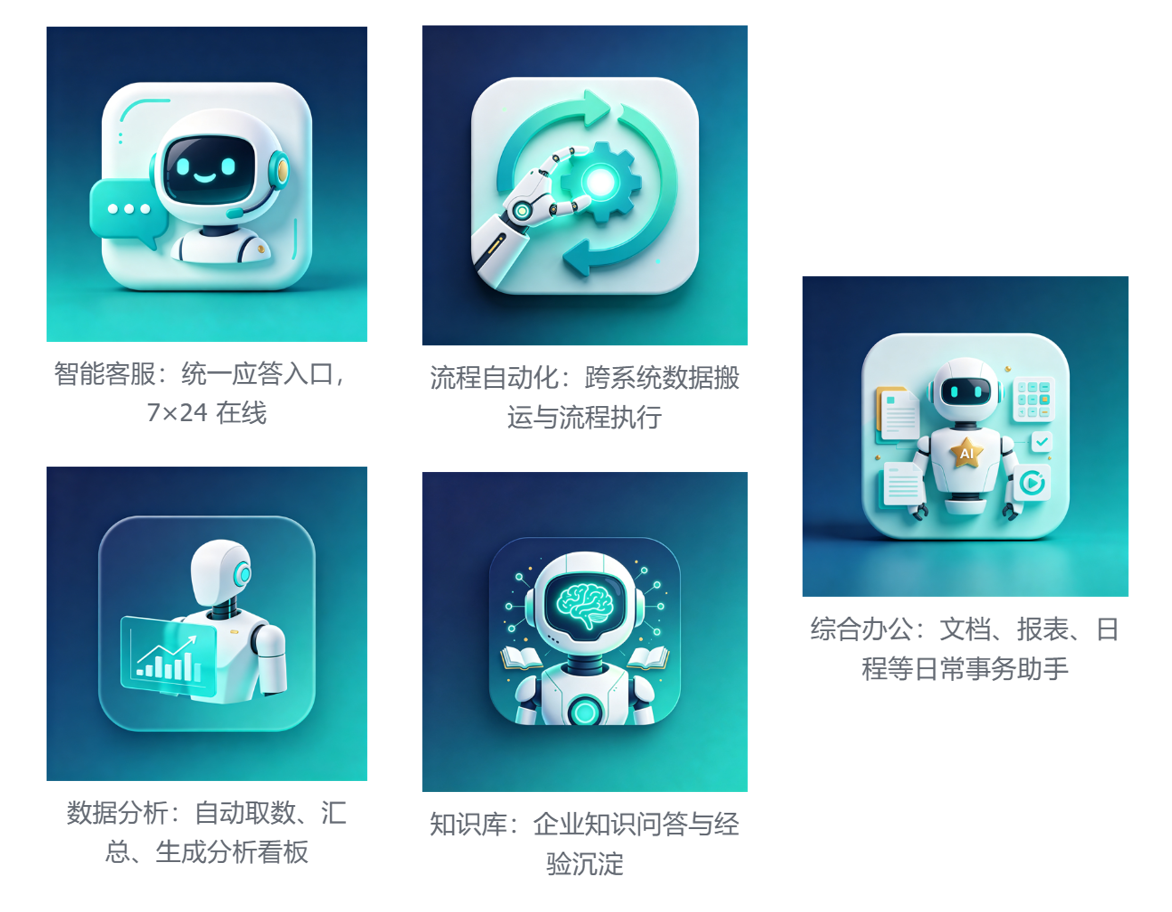
Role-based design, aligned with business needsFive roles: intelligent customer service, data analytics, process automation, knowledge base, and comprehensive office. Launch flexibly based on business needs—start with pilots, then scale.
Knowledge-controlled, secure and compliantUnified enterprise knowledge management, tiered access control, full-process auditability, and isolated validation for sensitive scenarios.
Measurable value, sustainable operationsEach digital employee is assigned business KPIs (efficiency, cost, quality, adoption) upon launch. Monthly reviews and quarterly planning ensure continuous elimination of low-value roles and expansion into high-value scenarios.
FDE provides end-to-end support with guaranteed implementation.On-the-job research, lightweight training, and seamless integration into existing workflows—affordable, adoptable, and valuable for frontline users.
01 AI Digital Employee Value
The true value of enterprise digitalization lies not in the number of systems, but in whether AI is integrated into real-world business operations. The value loop of an AI Digital Employee platform = Foundation Capabilities × Deep Scenario Exploration × Operational Execution—all three are essential.
02 Common Pain Points in Enterprise Digitalization
Without building this platform, the following issues will persist:
The system is ready, but no one is taking the final step.ERP, MOM, and office suites have been deployed for years, yet numerous repetitive, cross-system tasks that rely on experience still depend on manual work. Digital investments have not translated into frontline efficiency gains.
Knowledge resides with individuals, not organizations.Expert knowledge, policy guidelines, and historical solutions are scattered across individuals and documents; when people leave, their expertise leaves with them.
Fragmented AI ApplicationsEmployees use generic AI tools independently, with no unified access point, enterprise knowledge integration, or governance over permissions and compliance. This results in unmeasurable value and uncontrolled risk.
Manual intervention required at workflow breakpointsData migration, report consolidation, and cross-department follow-ups consume significant manual effort and are prone to errors with unclear accountability.
The Cost of Inaction: Human efficiency continues to erode due to repetitive tasks, AI benefits remain confined to tools rather than business outcomes, and the ROI on digital investments remains unclear.
03 Platform Advantages: Solution Objectives and Success Criteria
This solution aims to achieve four objectives:
Build a platformBuild a unified, controllable, and scalable enterprise AI digital employee platform using WorkBuddy, Doubao Work, or Deepseek Harness (3 of 1) as the industrial agent foundation.
Go to frontlineThe FDE team deploys AI into real-world business workflows, not just demos.
Deliver valueAchieve measurable efficiency gains, cost savings, or experience improvements during the pilot phase, and build reusable digital employee assets.
Can continueEstablish an operational framework for scenario evaluation, launch, measurement, and iteration to drive continuous value growth.
Success Criteria | Pilot Period (approximately 1 quarters) Acceptance Criteria |
|---|---|
Number of Scenarios Implemented | ≥ 3 real-world business scenarios successfully piloted and launched (actual count determined based on the pilot unit's current status) |
Boost Efficiency | Manual effort reduced by X% in pilot scenarios [Pending baseline data confirmation] |
Asset Accumulation | Build an enterprise-level Skill/Digital Employee Asset Library with ≥ N [Pending Verification] assets. |
Use penetration | Pilot Unit Active Usage Rate ≥ X% [Pending Verification] |
Note: X and N in the table above are baseline items pending pilot verification. At acceptance, actual measured data will be used to fill in the values; no artificially precise commitments are pre-set.
04 Enterprise AI Digital Employee Platform Implementation Strategy
4.1 Platform Positioning
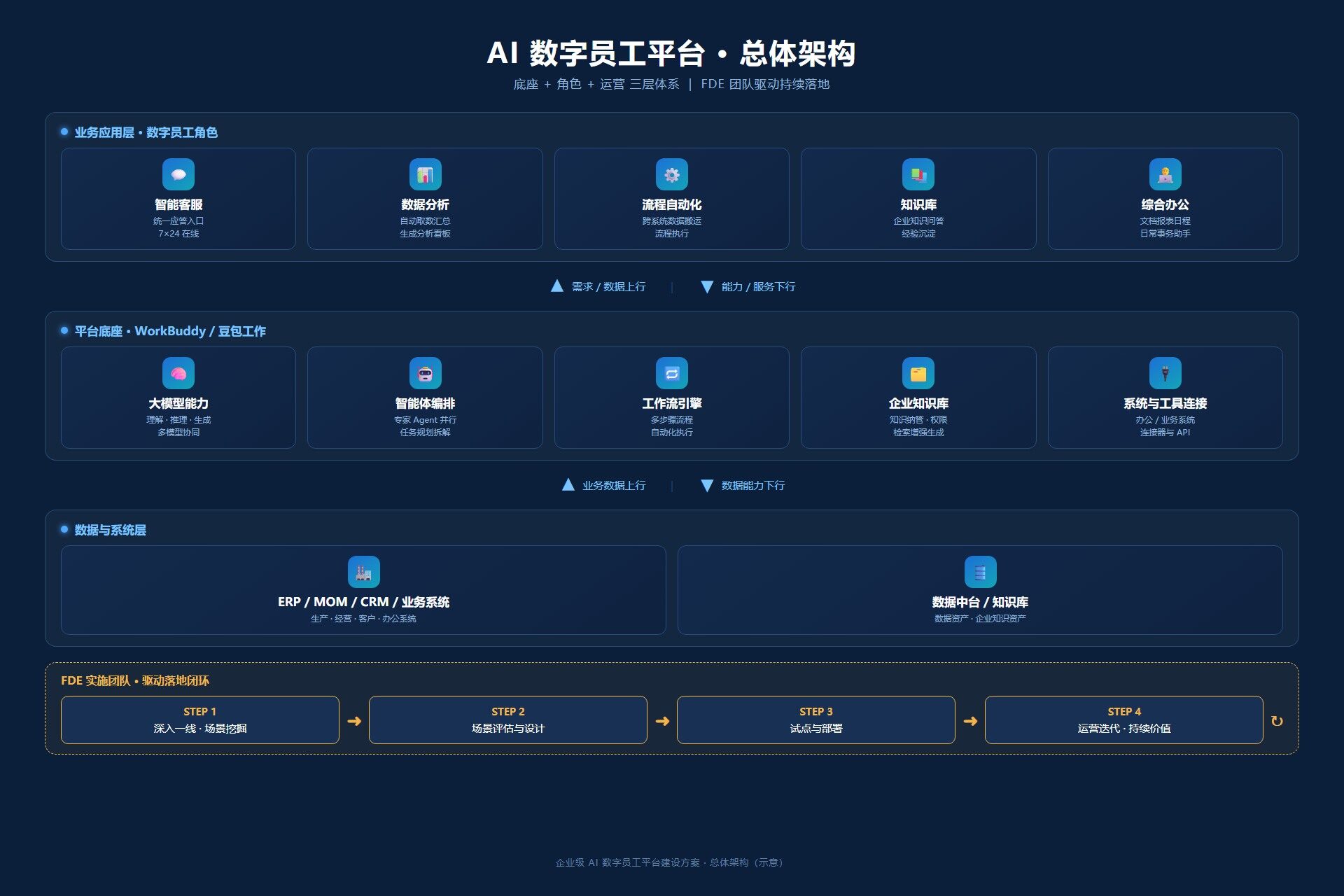
The AI Digital Employee Platform is a three-tier architecture comprising "Foundation + Roles + Operations." It leverages WorkBuddy or Doubao Workplace as the unified workspace and agent foundation to incubate digital employee roles tailored for specific business scenarios. The FDE team manages end-to-end execution, from scenario discovery to continuous operations.
4.2 Overall Architecture
The figure below illustrates the platform layering and the FDE implementation closed loop:
4.3 Core Design Principles
Prioritize base reuse: Prioritize native capabilities of the base platform (agents, workflows, knowledge bases, connectors); avoid reinventing the wheel.
Scenario-driven developmentAll platform capabilities are driven by real-world frontline requirements, not pre-built features.
Controlled knowledge and permissionsUnified enterprise knowledge management, role-based access control for digital employees, and full-process auditability.
Measurable ValueEach digital employee is assigned business metrics upon launch and included in operational KPIs.
05 Technology Stack Selection: WorkBuddy / Doubao Workspace / DSH
Overview of 5.1 base capabilities
The following comparison is based on publicly available information (subject to actual product capabilities upon activation).
Dimension | WorkBuddy (by Tencent Cloud) | Doubao Work |
|---|---|---|
Product Positioning | All-in-One AI Workstation for Office / Enterprise-Grade Agent Platform. Experts run in parallel to deliver complete results. | An AI-powered office agent system driven by the Doubao large model, deeply integrated with office suites like documents, spreadsheets, and calendars. |
Typical Capabilities | Multi-agent parallelism, enterprise knowledge base integration, business system connectivity, enterprise skill encapsulation and reuse, and enterprise-grade admin dashboard. | Agent/Workflow Orchestration, Enterprise Knowledge & Document Capabilities, Office Automation, Cross-Platform Collaboration |
Ecosystem & Connectivity | Connects to Tencent's office ecosystem and mainstream IM/tools, supporting multi-platform delivery. | Seamlessly integrated with Byte's productivity and collaboration ecosystem (Docs, Sheets, Calendar, Meetings, and more). |
Compliance and Control | Enterprise-grade admin console, organization and subscription management, plus permission and audit capabilities | Enterprise-grade security for permissions, data, and content (subject to activation) |
5.2 Selection Recommendation
Primary Criterion: Existing Enterprise Collaboration and Office Ecosystem— Prioritize a foundation that natively integrates with your existing office and data ecosystems to reduce integration costs.
Secondary Criterion: Scenario Complexity and Safety RequirementsWhen handling extensive system connections and multi-agent parallelism, prioritize validating the foundation connector and enterprise-grade control capabilities.
Suggested Actions: Conduct a 3-day real-world test for each base in the same scenario (select 1 high-frequency scenarios to compare performance, cost, and implementation timeline). Selection will be based on actual test results, not marketing materials.
06 Digital Employee Role System
During the pilot phase, prioritize incubating five categories of digital employees:
07 FDE Team Implementation Methodology: Go to the Frontline · Dig Deep into Scenarios · Deploy and Launch
FDE (Full-Stack Digital Engineer) is the core execution force for platform deployment, following the "Frontline Four-Step" methodology:
Go deep into business operations (identify use cases)Conduct on-the-job observations and interviews with frontline staff and team leaders to map three scenario types: repetitive tasks, cross-system breakpoints, and experience-dependent processes. Quantify the labor hours and frequency for each scenario.
Scenario Assessment and Design (Finalize Plan)Prioritize scenarios based on the "Value / Feasibility / Risk" framework, focusing first on those with the highest ROI and manageable risks. Clearly define the digital employee's role, inputs/outputs, permissions, and acceptance criteria.
Pilot and DeploymentSmall-scale pilot → Collect feedback → Iterate → Full launch; tie to business metrics and establish data baselines upon launch.
Operational Iteration (Sustained Value)Monthly operations review: track metrics, gather new requirements, and iteratively expand scenarios and roles. Build an enterprise skill asset library to create reusable rollout packages.
08 Implementation Roadmap (Phased Approach Recommended)
Stage | Key Actions | Phase Deliverables |
|---|---|---|
P0 Preparation Phase (1 Months) | Base selection validation, pilot unit confirmation, and frontline scenario inventory launch | Base Selection Conclusion, Pilot Scope, and Initial Scenario List |
P1 Pilot Period (1 Quarters) | ≥3 scenarios designed, developed, and piloted; baseline metrics established | Pilot Digital Employee Launch & Value Validation Report |
P2 Promotion Period (2 quarters) | Scenario replication and scaling, role expansion, and enterprise skill assetization | Platform-scale operation mechanisms and asset library |
P3 Deepening Phase (Ongoing) | Cross-domain agent collaboration with deep integration into MOM and the Data Middle Platform | Enterprise-Grade AI Digital Employee Operations System |
09 Value Measurement and Continuous Operations
Value measurement follows a "baseline first, metrics second" approach: collect manual time/cost baselines before each scenario goes live, then compare periodically after launch. Recommended metrics:
Efficiency Metrics: Single-task Duration, Report/Document Production Cycle
Cost Category: Reduced labor hours from eliminating redundancy, changes in manpower allocation
Quality Metrics: Error Rate, Compliance Rate, Response Timeliness
Penetration: Active Usage Rate, Scenario Adoption Count, Digital Employee Asset Reuse Count
Operational Mechanism: Monthly value review meetings and quarterly scenario planning sessions. Each quarter, low-value scenarios are phased out while high-value ones are expanded.
10 Cost and Resources (Estimated)
This section is an estimate and will be refined after base platform testing:
Base subscription cost:Billed by account count or usage (based on actual pricing for the two bases; recommend small-scale procurement during the pilot phase).
Implementation and Integration CostsFDE team investment (headcount × duration), with a minimum verifiable unit of ≥3 scenarios during the pilot phase.
Hidden CostsBusiness-side effort required for enterprise knowledge consolidation, permission review, and scenario baseline collection.
Recommendation: Start with a minimal pilot investment to validate before P1 ends. Based on the actual ROI, decide whether to scale up spending rather than committing to a large amount upfront.
11 Risks and Mitigations
Risk | Impact | Handle |
|---|---|---|
Incorrect scenario selected; pilot value not evident. | Pilot failed; investment wasted. | Scenario 3D Ranking (Value/Feasibility/Risk): Prioritize low-frequency, high-value breakpoints; define exit criteria for the pilot phase. |
Knowledge and Data Security | Data breaches, compliance risks | Unified enterprise knowledge management with tiered access control and full audit trails; isolate and validate in sensitive scenarios first. |
Non-compliance or inability to use at the frontline | Low penetration rate; value not yet realized | FDE: On-the-job support, lightweight training, and embedding digital workers into existing workflows instead of creating new ones. |
The base capabilities do not match expectations. | Rework, Delay | Conduct real-world testing in the same scenario 3 days before selection; reserve a transition buffer during the pilot phase (similar underlying architectures ensure manageable migration costs). |
12 Decision Entry
Please provide a decision from leadership on the following matters:
Approve the proposed direction and pilot scope (pilot units / scenarios / duration)
Confirm base model selection approach: decide after running side-by-side tests with WorkBuddy and Doubao in the same scenario, or specify the base model directly.
Approve FDE team formation and pilot-phase resource budget (specific amounts to be refined after base testing)
Confirm pilot value acceptance criteria and quarterly operational cadence