
Edge AI Cloud Platform
Edge Intelligence Platform: Data collection, real-time inference, and local decision-making occur at the production line edge, while the cloud handles model training, knowledge governance, and global optimization—forming a unified "Device-Edge-Cloud" collaboration system.
Product Details
AIoT Edge Intelligent Cloud Platform (ppb Extreme Manufacturing)
One-sentence positioning: ppb (parts per billion) level precision manufacturing (semiconductor wafers / packaging and testing, display panels, high-end PCBs, precision electronics) demands extreme control over defects, real-time performance, and data security. Quality inspection must operate at millisecond speeds; process data cannot leave the factory; and FDC/R2R control cannot tolerate cloud latency. An edge intelligence platform executes data collection, real-time inference, and local decision-making at the production line edge, while the cloud handles model training, knowledge governance, and global optimization—forming a unified "device-edge-cloud" collaboration architecture.
Industry Consensus: AI for semiconductor production lines should be deployed at edge nodes alongside equipment. FDC alarms require millisecond-level response; process data must not leave the factory; cloud latency would cause Run-to-Run (R2R) control failures. MaiShuoJiXin adopts a layered architecture of Edge – Fog – Cloud. The Edge layer handles millisecond-level preprocessing and local decisions (visual inspection, robot coordination), while the Cloud layer retains model training and global resource scheduling.
I. Platform Advantages
Drive scenarios by selecting high-value, closed-loop options.Prioritize AOI-based intelligent quality inspection (wafers/panels/PCBs), predictive maintenance (PdM/FDC), closed-loop process control (R2R), and energy/security management. Start with a single scenario that can be validated end-to-end.
Edge-cloud collaborative architecture firstCloud training, edge inference, and model OTA distribution. Adhering to "process data where it is used." Lightweight models run at the edge; large-scale models and scheduling optimization run in the cloud.
ppb-grade quality drives data and algorithm engineeringDefect samples are extremely scarce (few-shot approach starting with 30–50 labeled images). Requires balanced positive/negative samples, dual control of false alarm and miss rates, and traceability to individual items.
Data integration is the prerequisite.OPC UA is the universal communication protocol for semiconductor equipment (supported by major vendors such as ASML, Lam, and Applied Materials). We recommend running SECS/GEM and OPC UA in parallel with a gradual migration strategy. First, establish unified data modeling to ensure consistent field definitions across SCADA, CMMS, and QMS systems.
Network and Real-Time Performance: 5G Private Network / MEC, TSN Time Synchronization; Set inference latency budget (industry tests achieve <10ms inference, supporting 120fps production lines)
Model Engineering and Fault ToleranceQuantization, distillation, and pruning for model compression; model repository with version control and canary releases; edge multi-model coexistence with fault-tolerant switching, offline execution with cloud fallback.
Security & ComplianceOT/IT segregation, data residency, access control, and audit; FDC/R2R controls must include manual or rule-based fallback.
Metrics SystemFalse Positive Rate, False Negative Rate, Inference Latency, Model Iteration Cycle, OEE and Yield Improvement
Organization & OperationsCollaboration among IT, OT, process engineering, and algorithm teams. Labeling and model operations are long-term investments, not one-time projects.
Staged investmentAvoid aiming for a one-size-fits-all rollout on large platforms; validate value through pilot programs before scaling.
II. Platform Architecture
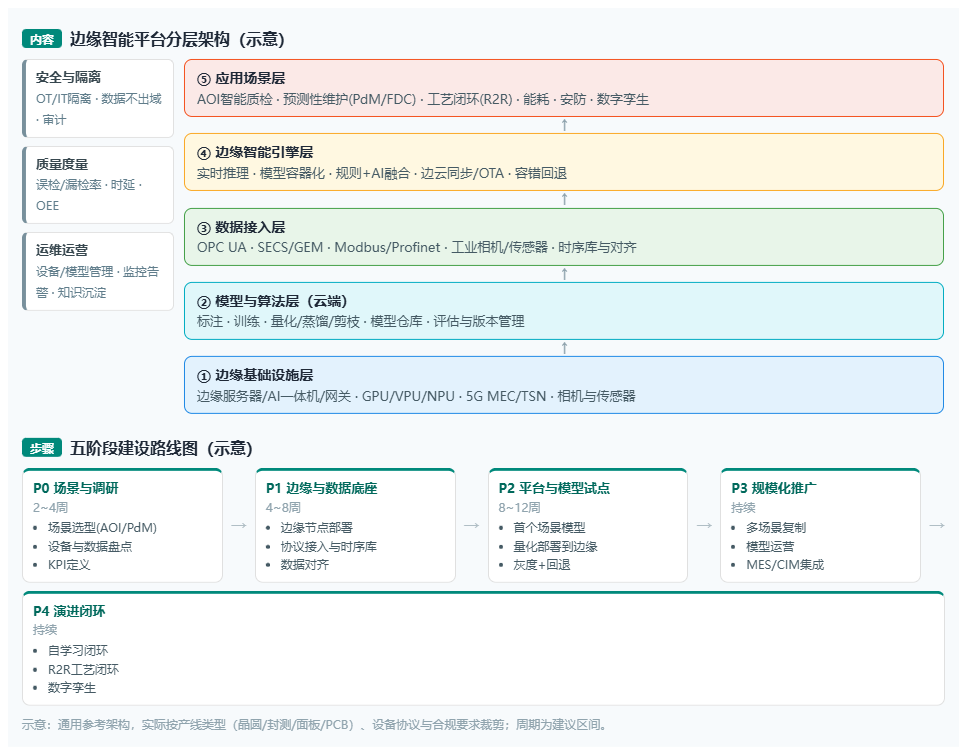
Press6 layer + 3 cross-cutting capabilitiesPlan (see figure):
Edge Infrastructure LayerEdge Servers / AI Appliances / Smart Gateways, Industrial Cameras & Sensors, GPU/VPU/FPGA/NPU Computing Power, 5G MEC/TSN Networks
Data Access LayerOPC UA / SECS-GEM / Modbus / Profinet protocol integration, video stream ingestion, time-series data cleaning and alignment, and resume-on-disconnect.
Edge Intelligence Engine LayerReal-time inference services, containerized model deployment, rule engine + AI integration, edge-cloud synchronization and OTA, fault tolerance and fallback
Model and Algorithm Layer (Cloud)Data Annotation, Model Training, Quantization, Compression & Distillation, Model Repository, Evaluation & Version Management
Application Scenario LayerAOI inspection, predictive maintenance (PdM/FDC), closed-loop process control (R2R), energy optimization, security behavior recognition, digital twin
Platform ManagementDevice and algorithm management, monitoring and alerting, permission auditing, knowledge accumulation
Cross-cutting: Security and IsolationOT/IT isolation, data stays within the domain, audit trail
Cross-Cutting Quality MetricsFalse Positive / False Negative Rates, Latency, Model Iteration Cycle, OEE / Yield
Cross-cutting · Operations & SRE: Device and model lifecycle, annotation operations, knowledge base accumulation
3. Implementation Roadmap
Table
Stage | Cycle | Objectives and Key Actions | Outputs and Milestones |
|---|---|---|---|
P0 Scenarios and Research | 2–4 weeks | Scenario selection (AOI/PdM priority), asset and data inventory, data sensitivity classification, KPI definition | Scenario Roadmap and Project Initiation Plan |
P1 Edge and Data Foundation | 4–8 weeks | Edge node deployment, OPC UA/SECS-GEM protocol integration, time-series database and data alignment | Operational Data Foundation |
P2 Platform and Model Pilot | 8–12 weeks | First scenario: model training, quantization and deployment to edge, gray release with rollback mechanism, and evaluation set acceptance. | First scenario passed acceptance. |
P3 Scalable Rollout | Continue | Multi-scenario replication (PdM, energy consumption, security), model operations mechanism, and integration with MES/CIM. | Production-line-scale deployment |
P4 Evolution Closed Loop | Continue | Self-learning closed-loop, R2R process closed-loop control, digital twin | Platform Deepening and Evolution |
IV. Implementation Strategy (Pitfall Avoidance Checklist)
Providing only compute power without connecting data → Platform runs idle
Wrong scenario selection (low frequency, non-closed loop) → Value cannot be demonstrated
Insufficient defect samples lead to model misses; unacceptable at ppb-level requirements.
Edge compute and model mismatch → inference timeouts, production line cycle times lag
No fallback mechanism → Model misjudgment halts production line
Bypassing protocol barriers → Over 90% legacy PLCs/DCS support only OPC UA Basic or Modbus TCP, preventing AI decisions from reaching devices.