

Enterprise-Grade AI Knowledge Platform
Unify enterprise knowledge scattered across documents, cloud storage, and business systems into a centralized hub that is manageable, queryable, searchable, and ready for AI consumption. Built not just to store knowledge, but to transform it into an assetized, service-oriented, and intelligent resource—the essential fuel for RAG-based Q&A, Copilots, and AI agents.
Product Details
Enterprise AI Knowledge Platform
One-sentence positioning: The Knowledge Hub unifies enterprise knowledge scattered across documents, wikis, IM tools, emails, and business systems into a centralized asset that is manageable, queryable, searchable, and AI-ready. It is built not to store knowledge, but to empower it.Assetization, Service-oriented, IntelligenceFuel for AI applications such as RAG-based Q&A, Copilot, and intelligent agents.
Core Consensus:The ceiling of AI is determined by knowledge quality. The first step in onboarding isn't vectorization—it's governance.Architecturally, it generally adopts a layered design of "ingestion → governance → processing → retrieval/generation → service," where each layer can evolve independently to avoid large-scale, one-time refactoring.
1. Platform Architecture
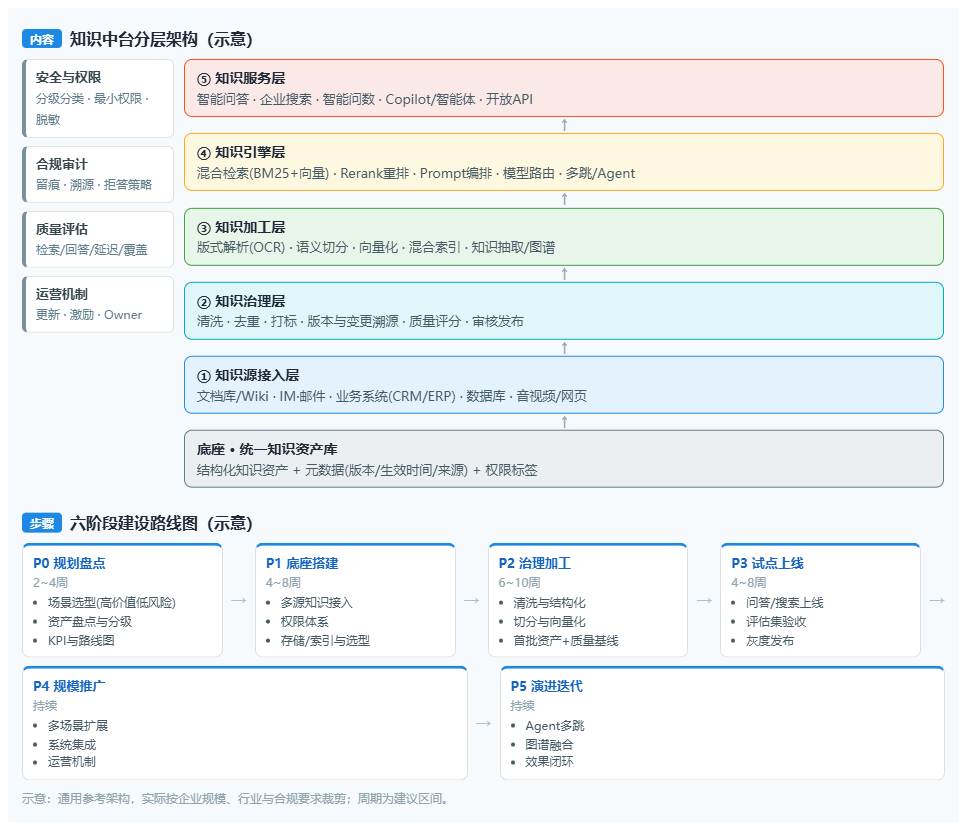
Press6 layer + 2 cross-cutting capabilitiesPlan (see figure):
Knowledge Source Access LayerConnect to multi-source, heterogeneous data including document repositories, Wikis, IM/email, cloud storage, business systems (CRM/ERP), databases, audio/video, and web pages. Supports incremental sync, deduplication, OCR, and multi-language processing. Zhiyuan Interconnection
Knowledge Governance Layer: Cleaning, deduplication, expiration alerts, categorization and tagging, version tracking and change auditing, quality scoring, review and publishing. Mature solutions provide a visual governance dashboard to lower the maintenance threshold for business users. Xinhua Daily Press Network
Knowledge Processing LayerComplex layout parsing (cross-page tables, mixed text and images), semantic/recursive chunking, vectorization, hybrid indexing, knowledge extraction, and graph construction
Knowledge Engine Layer: BM25 + Hybrid Vector Retrieval, Reranking, Prompt Orchestration, Model Routing, Multi-hop Retrieval, and Agent Orchestration
Knowledge Service LayerIntelligent Q&A, Enterprise Search, Smart Data Querying, Copilot / Agents, and Knowledge Portals—all delivered via a unified API.
Foundation · Unified Knowledge Asset RepositoryStructured knowledge assets + metadata (version / effective date / source) + permission tags
Cross-Cutting · Security & ComplianceKnowledge classification and grading, least-privilege access, data masking, audit logging, refusal protocols, and human agent escalation
Cross-functional Operations Assessment: Effectiveness Metrics, Update Mechanism, Contribution Incentives, Knowledge Owners
II. Key Success Factors
Scenario-first, value-drivenStart by piloting 3 to 5 high-value, low-risk scenarios (policy Q&A, customer service scripts, product FAQs, IT operations, new hire training) to validate the workflow before scaling. Note: Fewer than 20% of successful pilots can be scaled effectively; scaling is where most initiatives fail.
Govern first, then enable intelligenceDo not load the entire historical dataset at once, as this can reduce accuracy. For cold start, prioritize cleaning high-frequency existing knowledge (Customer Service Scripts, Product FAQs, and IT Operations Manuals) while preserving metadata such as title, section, table, page number, version, effective date, and source.
Splitting and retrieval are the key differentiators for performance.Prioritize semantic understanding with recursive chunking and small overlaps; hybrid retrieval (vector + BM25) improves accuracy by approximately 10 percentage points (73.6%→83.7%) compared to vector-only retrieval, followed by Rerank filtering for irrelevant chunks. Chunking experiments show that recursive chunking yields significantly higher answer accuracy than fixed-length chunking (approximately 76% vs 55%).
Evaluation closure is essential.Evaluate across four dimensions: retrieval recall, answer accuracy, response latency, and knowledge coverage. Build an evaluation set of 50 to 100 representative questions and continuously measure using metrics such as faithfulness and answer relevancy.
Security and compliance are non-negotiable.Permissions, classification, data masking, and auditing must be implemented first. Configure "friendly refusal + transfer to human agent" policies to prevent AI hallucinations or internal data leaks.
Platform + Open APIStandardize search and Q&A services to avoid building separate solutions for each scenario.
Organization and Operations SupportBusiness experts, IT, and data teams collaborate with designated Knowledge Owners and update mechanisms to keep knowledge active.
III. Implementation Steps (Six-Phase Roadmap)
Stage | Suggested Cycle | Objectives and Key Actions | Output |
|---|---|---|---|
P0 Planning Review | 2–4 weeks | Scenario selection, knowledge asset inventory, data sensitivity classification, and KPI definition | Requirements List and Roadmap - Xinhua News Network |
P1 Base Setup | 4–8 weeks | Multi-source knowledge ingestion, permission management, storage/indexing, and platform selection (self-built or vendor-provided) | Supported Platforms |
P2 Governance Processing | 6–10 weeks | Clean structured data, chunk and vectorize, launch initial assets, establish quality baseline | High-quality knowledge base |
P3 Pilot Launch | 4–8 weeks | Smart Q&A / Search Launch, Evaluation Set Acceptance, and Gradual Rollout (not a full launch at once) for WPS 365 | Pilot scenario validated |
Scale P4 | Continue | Multi-scenario expansion, business system integration, and operational mechanisms (updates, incentives, training) | Available to all |
P5 Evolution and Iteration | Continue | Agent Multi-hop Reasoning, Knowledge Graph Integration, and Closed-loop Effectiveness with Version Control | Deepen the Middle Platform |
IV. Implementation Strategy
Building models without governance → inaccurate answers and hallucinations
Ship without evaluation → No optimization, no value proven
Insufficient permissions → Risk of data breach
Successful pilot, failed rollout → Missing operations framework and business owner
Prioritize phased implementation based on business needs rather than pursuing a one-time, all-in-one solution.
Related Products
Smart Operations Data Decision Platform
Cloud platform for superior enterprise operations and collaborative efficiency. Connects R&D, manufacturing, supply chain, sales, and service with integrated data, deep-dive metrics, and intelligent decision-making.
SuperBI Data Analytics Platform
Powerful data analytics tool to help businesses unlock data value