
AI Agents in the Workshop: A MOM Manufacturing Operations Solution Built on WorkBuddy
AI Agent + MOM: Bridging the Gap from "Chatting" to "Getting Things Done" with a Robust Foundation.

AI Agents in the Workshop: A MOM Manufacturing Operations Solution Built on WorkBuddy
2026 10 · Smart Manufacturing Insights
Many factories have deployed MES/MOM systems for years, with data stored in the system. Yet production scheduling still relies on experienced workers, quality issues are monitored manually, and material shortages are tracked via phone calls.
On the other side, transformation is underway: after deploying a manufacturing operations AI agent, one company compressed its order cycle from an industry average of 38.4 days to 7 days and boosted delivery efficiency by 82%; another electronic manufacturing line reduced manual rework for AI-powered quality inspection by 30%.
The difference isn't whether you have a system; it's how you understand the same problem:An AI Agent isn't just a chat interface added to MOM; it's a fundamental shift in how manufacturing operations run—and that requires a foundation built to truly support it.
This article covers four key points: where MOM is currently stuck, how AI Agents can drive change, why a production-grade foundation is essential, and what a solution built on the WorkBuddy platform looks like.
01Where does MOM get stuck in the workshop?
Let's clarify the concepts first. MOM (Manufacturing Operations Management) is a broader concept than MES, encompassing all manufacturing operations activities such as production, quality, inventory, and maintenance. MES is its core component, focused specifically on production execution. Modern MES is evolving into an MOM platform—in short, MOM manages "the entire workflow in the workshop from order receipt to shipment."
The issues with this system are summarized in the industry as three major hurdles:
Data silo.Industrial data suffers from inconsistent quality, fragmented standards, and broken context. Algorithm teams joke that 80% of their time is spent on "data archaeology"—endlessly guessing which business form a given time-series signal corresponds to. Without unified metrics and missing labels, even vast amounts of data cannot yield reliable insights.
Scene Can.Manufacturing Know-How presents a high barrier to entry. General-purpose AI models struggle to handle the vast diversity of specific processes and anomalies: a "line stoppage" in stamping, SMT, or final assembly lines has entirely different root causes and remediation steps.
Execute.This is the most overlooked hurdle: AI can offer recommendations but struggles to trigger system actions and close business loops. Whether suggestions stay on-screen or require manual execution makes all the difference in value.
Conclusion: MOM has plenty of data; what it lacks is an executor to connect data, rules, and actions.
02AI agents in manufacturing operations don't just change a feature—they transform an entire way of working.
In a manufacturing operations context, an AI Agent can be understood as a "digital shop floor worker": it understands business goals, breaks down complex tasks into steps, calls upon data and tools within the system to execute actions, and delivers results. Its fundamental distinction from traditional AI lies in its ability to "get things done"—it can trigger actual system actions and complete full operational loops.
Integrated into MOM, it transforms four types of work practices:
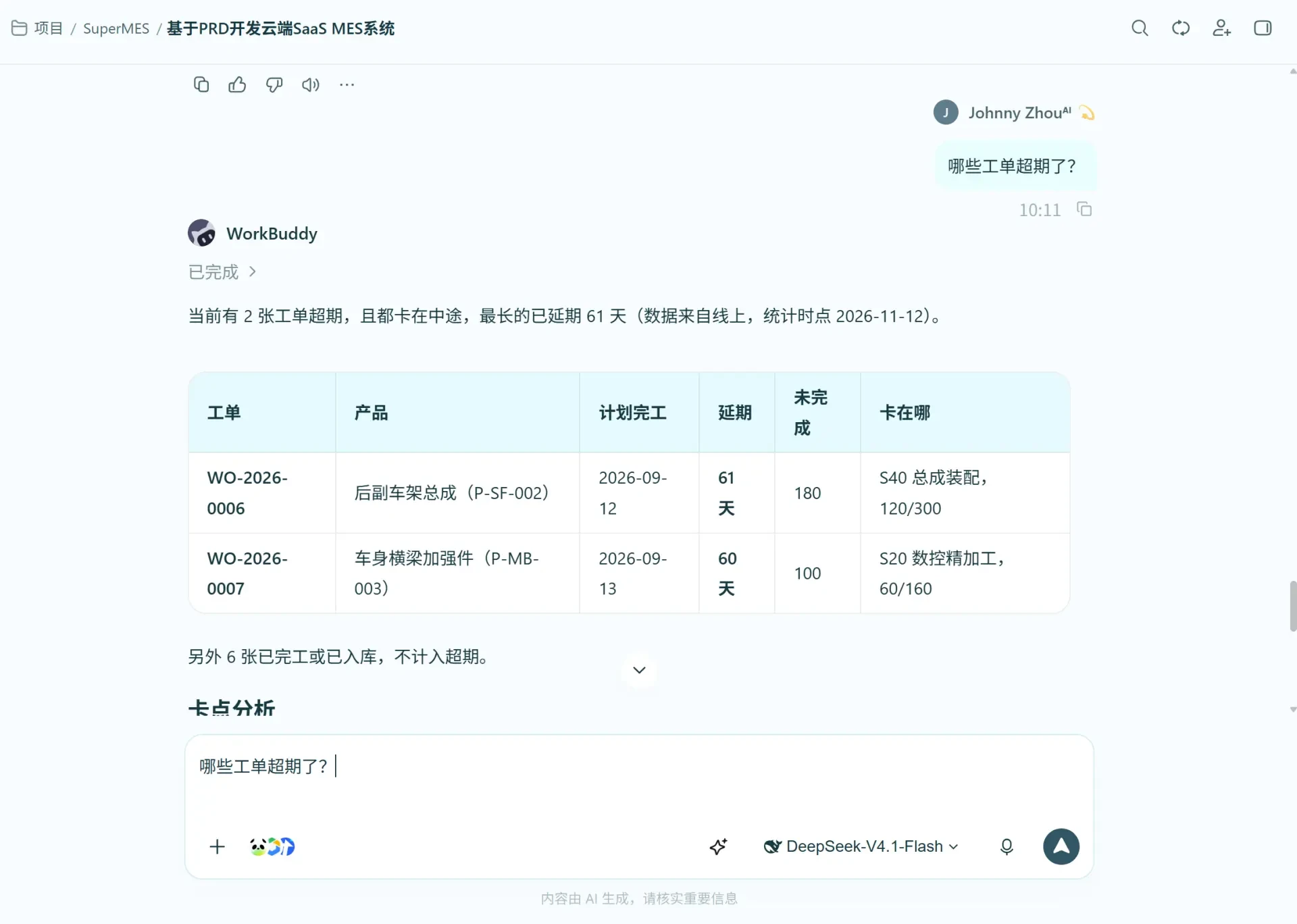
Perception.Real-time production line monitoring: equipment utilization, WIP location, inventory levels, and quality inspection results. Automatic anomaly alerts—no need to wait for end-of-day reports.
Decision.Schedule production, assess quality, and diagnose equipment based on real-time data: predict material arrival times, identify available machines, and flag potential order bottlenecks in advance—relying on data-driven insights rather than intuition.
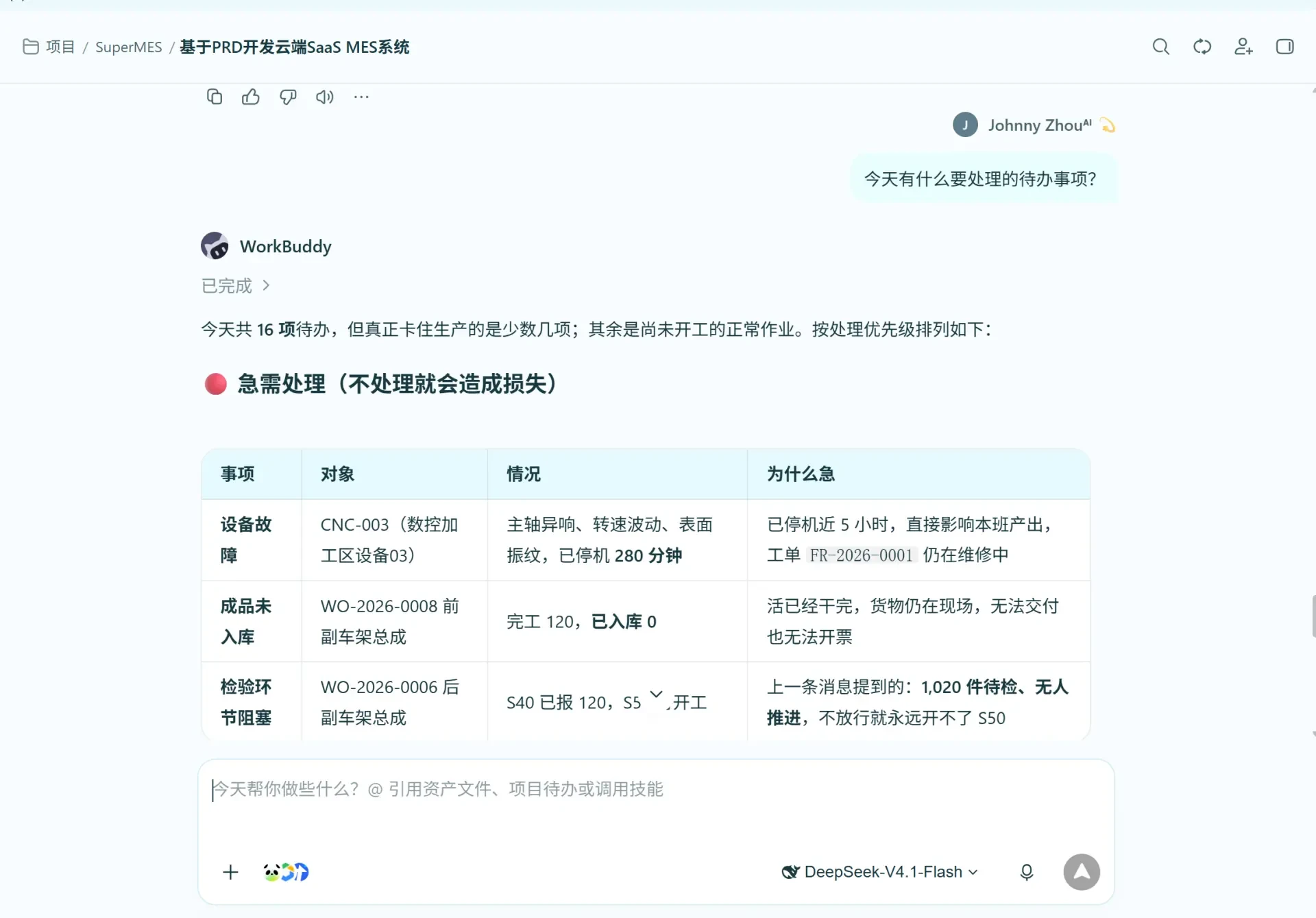
Execute.Directly trigger system actions: automatically reschedule production, issue quality inspection tasks, and freeze abnormal batches—turning "suggestions" into "actions."
CollaborateConnect planning, procurement, production, quality, and logistics: a single material shortage alert that automatically triggers procurement follow-up, production rescheduling, and delivery commitment updates.
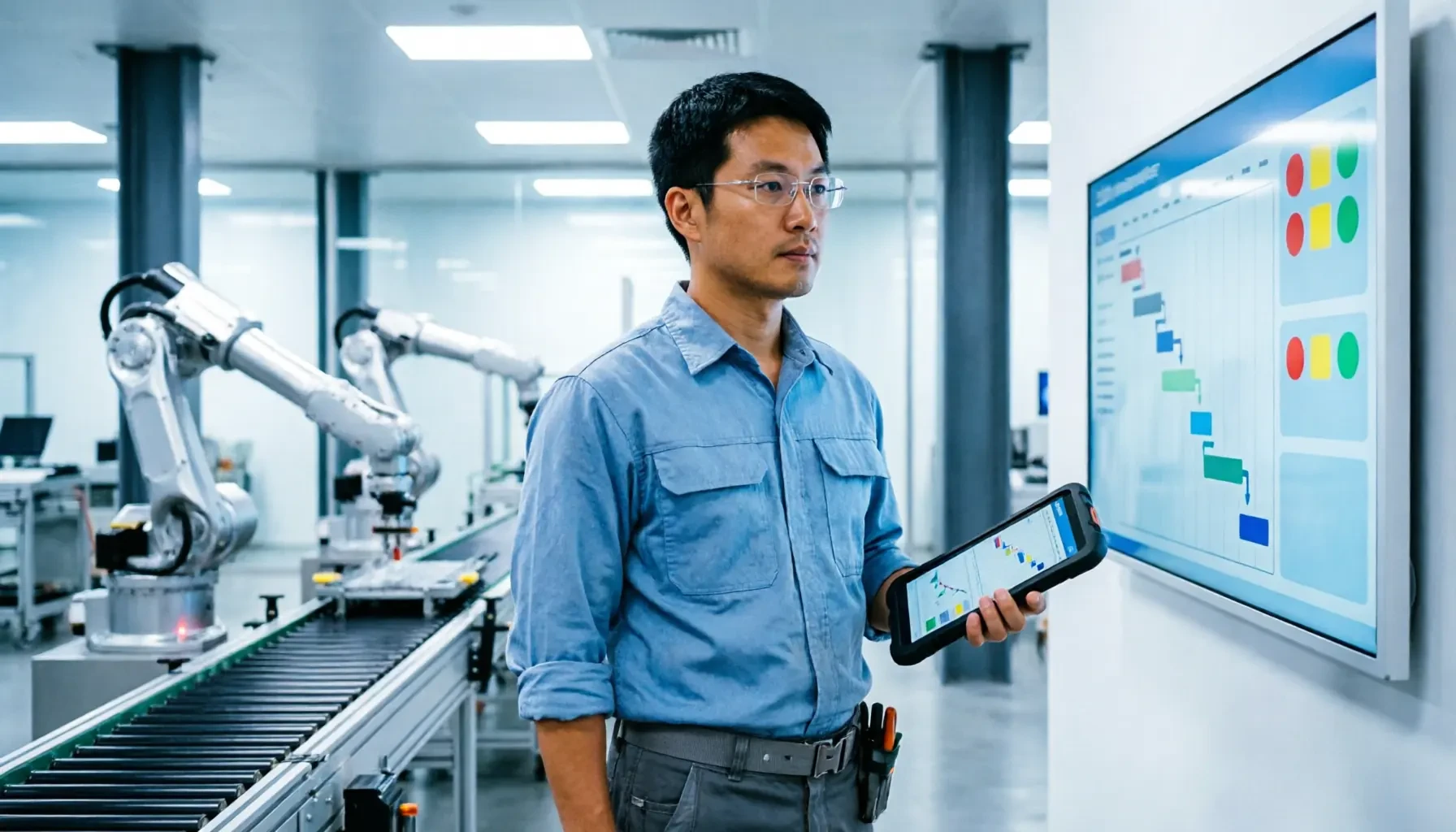
Industry practices are already validating these scenarios. Lenovo's Manufacturing Operations Agent covers five core use cases, including intelligent production scheduling. By simulating dynamic relationships among global raw material inventory, equipment status, and logistics routes, it reduces order cycle times from an industry average of 38.4 days to as low as 7 days, improves delivery efficiency by 82%, and lowers inventory holding by 81%. In electronics manufacturing, AI-driven scheduling systems simulate production flows for the next 72 hours: if a key chip is expected to arrive tomorrow afternoon, the system automatically schedules the corresponding project for the following morning while simultaneously calculating stencil and fixture readiness times. On the materials side, automotive companies use AI assistants that proactively alert teams daily about material shortages and at-risk work orders—acting on their own rather than waiting for queries.
03From "Chat-Only" to "Action-Ready": Why You Need a Foundation
At this point, many people's first question is: "Can't I just use an AI chat tool for these capabilities?"
The answer lies in the execution loop of manufacturing. Conversational AI can offer "recommendations," but manufacturing operations demand "actionable triggers"—rescheduling production, dispatching quality inspections, freezing batches, and coordinating procurement. The critical link missing here is:Can the agent safely, stably, and traceably operate the system?
A truly capable manufacturing operations agent must possess at least four layers of capabilities:
Orchestrate.Break down long tasks (e.g., "Reschedule the SMT production line for this week") into multiple steps and execute them in order, rather than using a question-and-answer format.
Memory.Maintain context across tasks—consistency is ensured by considering the previous day's scheduling constraints, last month's quality inspection rules, and this supplier's historical delivery performance.
Action.Call the business system in a controlled manner—read MES work orders, write scheduling results, and trigger approvals. Each step enforces strict permission boundaries.
Control.Unified identity, end-to-end traceability, and measurable outcomes. Only when exceptions can be traced back and rule changes validated can Agents be "trusted with delegated authority."
These four layers of capability constitute the true value of the "foundation."Deploy every Agent on a production-grade foundation, not scattered across isolated experiments.
04What does a solution built on the WorkBuddy foundation look like?
WorkBuddy Enterprise is Tencent Cloud's all-in-one AI agent platform for enterprises. Built on the core of Tencent Hunyuan large models and supporting multi-model integration, it enables businesses to develop production-grade AI capabilities that are controllable, operable, and scalable. As the overarching brand and unified foundation, it comprises three products: CodeBuddy for intelligent coding, WorkBuddy for AI-powered office collaboration, and WorkBuddy Managed Agents for agent hosting and large-scale operations.
In the context of manufacturing operations, the core logic of this solution is:Agentize MOM capabilities—including scheduling, quality inspection, equipment management, and material handling—so they run on the WorkBuddy Harness kernel.
The WorkBuddy Harness core integrates four capabilities: agent orchestration, memory, action, and governance—exactly the four prerequisites for "getting things done" discussed earlier. WorkBuddy Managed Agents provide cloud-hosted intelligent agent services featuring isolated sandboxes, 7×24 hours of continuous operation, automatic sleep, and millisecond-level recovery. These agents connect directly to Tencent Cloud's full-stack foundation and elastic computing resources, scaling seamlessly from dozens to tens of thousands without requiring code refactoring. In short, you can pilot a scheduling agent on a single SMT line today and expand it across all 30 group factories tomorrow—all without rebuilding your infrastructure.
For manufacturers, two critical concerns are addressed with purpose-built solutions: 1) Security: All sensitive data—including Skill configurations and MCP call results—resides exclusively in the cloud within your domain. Agents access business systems securely via unified identity management. 2) Governance: Full lifecycle governance covers unified identity, isolated runtime environments, end-to-end tracing, performance evaluation, and continuous optimization. This establishes deterministic operational boundaries and quantifiable quality baselines for every Agent.

05Implementation path: start with a high-frequency use case
Even the best plans require step-by-step execution. Here are four recommendations for manufacturing companies:
Step 1: Select a scenario.Start with high-frequency, low-risk scenarios with clear feedback loops. Material availability alerts, intelligent scheduling recommendations, and quality inspection review assistance are easier to launch and validate than "full-factory intelligence."
Step 2: Organize the rules.Clarify the rules, permissions, and data definitions for this scenario first: what constitutes an anomaly, who can trigger actions, and where the data originates. Without clear rules, the Agent cannot proceed.
Step 3: Verify the closed loop.Pilot on a single production line or in one workshop to verify that the Agent can "trigger actions and complete closed loops," not just provide recommendations. This step builds trust.
Step 4: Expand further.Transform validated agent capabilities into reusable assets and scale them across more production lines and scenarios. The platform's elasticity and governance are designed to support this large-scale expansion.
From an industry practice perspective, the path is clear: some companies have transformed their scheduling agents from "firefighters" to "prophets," shifting from reactive responses to material shortages to proactive risk prediction; others have reduced re-inspection rates by 30% and cut down manual secondary verification workload downstream. Start with one success, then scale to a hundred.
06Framework: Which Agent Should Your Factory Deploy First
To determine if a factory can gain real value from AI Agent + MOM, ask these four questions first:
Can the data be understood by an Agent?Is the device protocol compatible? Are all tags present? Is the data口径 consistent? If the data cannot be understood, the faster the Agent runs, the more errors it produces.
Can rules be written as actions?Can production scheduling logic, quality inspection standards, and shortage thresholds be transformed from expert intuition into machine-executable rules?
Can you effectively manage permissions and boundaries?What systems can the agent access, what actions can it trigger, and who approves them? If we can't control these, we won't delegate authority.
Is there a foundation ready to support scaling?Pilot successful. Can we replicate this across 30 factories? The foundation sets the ceiling.
Technology can be bought; the foundation and scenarios must be built in-house. AI agents entering manufacturing operations aren't just a software purchase—they're a fundamental shift in how things run: from "people monitoring systems" to "people set boundaries, agents execute, and systems run autonomously."
The real question isn't whether AI will replace anyone on the shop floor, but whether manufacturing operations are ready to bring agents into the workflow.Has your factory's MOM been deployed? Where are you stuck—data, scenarios, or the foundation?
Related Solutions
Enterprise AI Transformation + FDE Advisory Coaching
Provides end-to-end AI-driven digital transformation top-level planning and full-cycle implementation support for enterprises.
When SRM Meets AI Agents: Supply Chain Management is Evolving
Has your enterprise implemented SRM? Where are you stuck—data, rules, or organization?
How to scale enterprise-grade AI digital employees? 90% of companies get stuck here.
AI is not a workforce reduction tool—it's an efficiency multiplier: the right way for enterprises to scale AI adoption.