
Practical Guide to Supplier Master Data Governance
Don't let one supplier appear as three different entities in the system.

Practical Guide to Supplier Master Data Governance
2026 · 10 | AI Agent + SRM Series

Figure 1: Unified management of supplier master data — single source of truth
The same supplier is listed as "Huawei Technologies Co., Ltd." in the procurement system, "Huawei" in the finance system, and "HW-001" on invoices. This isn't because the supplier has three identities; it's because your vendor master data is inconsistent.
In our previous article, we discussed why data governance must come first and outlined the four-step framework. This post focuses on the supplier domain, breaking down actions into clear, executable steps: how to identify duplicate suppliers, how to merge them into a "golden record," how to prevent duplicates from recurring, and what truly sustains effective governance.
Supplier master data is the foundation of the SRM system and AI Agents. Any cracks in this foundation will ultimately impact payments, negotiations, and supply chain continuity.
01Why Supplier Data Is Messy: Where the Chaos Lies and Where the Costs Add Up
Supplier data chaos typically manifests in three forms:
Multiple codes, multiple names.The same entity is often registered as multiple records across different systems and departments, with inconsistent naming (abbreviated or full) and fragmented coding schemes. After a pharmaceutical group expanded through acquisitions, it faced duplicate payment risks due to non-uniform supplier data. The chaos was ultimately contained by implementing a flexible standard: "Group Master Code + Site Extension Code."
Outdated information, missing fields.Expired credentials go unnoticed, bank account changes aren't updated, and contact info becomes obsolete. Key suppliers are unreachable during emergencies, directly threatening production and delivery.
Confusing accounts and inconsistent standards.Financial loss due to incorrect account information or duplicate payments to the same vendor under different aliases during checkout.
The hidden cost of these issues is calculable: procurement spend gets fragmented across multiple suppliers, preventing companies from aggregating total volume per vendor. This weakens negotiating leverage and forfeits bulk discounts. Risk data becomes siloed, leaving compliance gaps until audits reveal them.
02Step 1: Identification – How to Find Potential Duplicate Suppliers
Before clearing duplicates, you must first identify them. Use a two-pronged approach: system matching to expand coverage and manual review to ensure accuracy.
Deterministic matching.Perform exact matching using unique identifiers: Unified Social Credit Code, Tax ID, Bank Account Number, and Enterprise Registration Number. If these identifiers match, it is highly likely that the entities are the same.
Fuzzy Match.When a unique identifier is missing, calculate similarity based on name, address, and contact details. High name similarity, matching addresses, or matching last digits of the tax ID are flagged as potential duplicates. Adjust the threshold dynamically: too high risks missed matches; too low generates excessive items requiring manual review.
Manual review.The system can only flag candidates; final confirmation requires human verification through physical or archival comparison, technical parameter checks, and cross-verification of historical procurement records. All three criteria must be met to confirm a duplicate.
Priority SortingSort by citation frequency: Prioritize vendor records with the highest usage across purchase orders, contracts, and inventory logs for maximum cleanup impact. Defer low-frequency records. Focus resources on high-impact areas rather than attempting a full cleanup in one pass.
03Step 2: Match and Merge to Create a "Golden Record"
After confirming duplicates, the core action is to merge: extract the most accurate and complete supplier information from each source system into a single authoritative record—the "golden record" in master data management.
Merging involves four key actions:
Select master record.Records with high usage frequency and broad citation scope are prioritized as master records; all other records are merged into them.
Move citation.Consolidate duplicate inventory, procurement, contract references, and bank information into the master record. Reconcile procurement totals and restore accurate cost accounting.
Freeze old codes.Duplicate codes are marked as "merged" and frozen, and will not be used for new transactions. They remain visible in queries, but the system displays a warning: "This code has been merged; please use the master code."
Preserve mapping.Establish a long-term mapping between legacy codes and master codes. Legacy codes in historical documents are automatically converted to master codes during queries, ensuring complete traceability of historical data.
Using Angang Group as an example: its intelligent material cleaning system leverages large models to understand material names, characteristics, and quality inspection standards. It achieves over 90% accuracy in repeated recognition, has cleaned up 68 million redundant data entries, and frozen 30 million invalid codes. Recognition and merging can be significantly accelerated by technology.
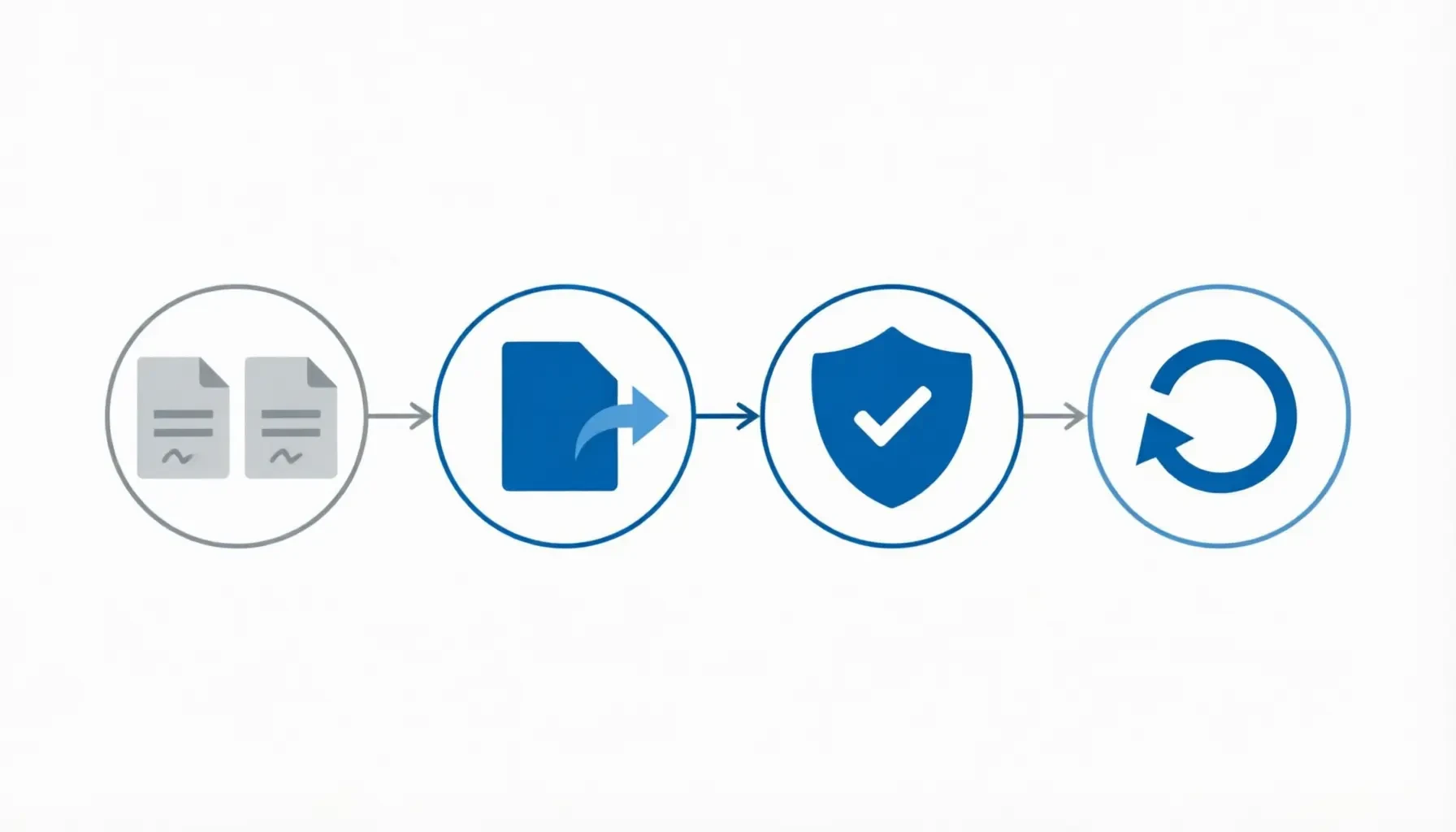
Figure 2: Four-step process for identifying and merging duplicate suppliers
04Step 3: Intercept — Prevent Recurrence
Finishing the backlog is just the first half. The real challenge lies ahead: ensuring new records never become duplicates. This hinges on three things:
Unified application portal.All supplier onboarding and updates must go through a single unified portal. Email or offline requests are not accepted. The portal enforces duplicate checks: upon submission, it automatically searches the existing supplier database. If the similarity exceeds the threshold, manual confirmation is required to verify whether the supplier already exists.
Standardize names and required fields."Name + Unified Social Credit Code + Account Information" are required and must be unique. Name formats are standardized to eliminate the creation of records using abbreviations from the source. In S Company's food enterprise case, the three-tier validation of "Code + Name + Specification" reduced material duplication rates from 18% to 2%.
Review regularly.Review new records quarterly for duplicates; the mechanism is effective only if the duplicate rate remains low. If it exceeds limits consecutively, audit the deduplication rules and naming system for gaps.
05Governance requires more than technology: it needs the right organization and processes.
The biggest pitfall in supplier master data governance is treating it as a system project. In reality, it's half data engineering and half organizational change.
The most effective practice in real-world scenarios is to clearly define four roles:
Applicant (Business User).Submit data per the Submission Guide. To register a supplier, provide key fields including name, unified social credit code, and qualifications.
Approver (Business Manager).Approve via workflow; for example, supplier information requires qualification confirmation by the Procurement Supervisor.
Administrator (Information/Data Department).Monitor data quality and regularly clean up redundant data.
User (end-to-end business chain).Get standardized data from a unified platform to reduce cross-system reconciliation costs.
Supplement with policy documents such as submission guidelines, maintenance standards, and operation manuals to institutionalize "who submits, who approves, who manages, and who uses." Once the process is embedded in the system, governance no longer relies on individual accountability.
06Phased implementation and validation
Supplier master data governance should be advanced in three phases, each with defined actions and validation metrics:
Phase 1: Prioritize high-frequency items.Clean the top 20% of supplier records most frequently referenced by orders, contracts, and inventory. After this phase, procurement return rates and payment error rates should show observable improvements.
Phase 2: Full coverage of existing inventory.Clear remaining inventory in batches by category or region, 1–2 categories per batch. Validate the reduction in duplication rate after each batch is completed.
Phase 3: Rule Consolidation and Monitoring.Standardize encoding rules and naming conventions. The system automatically generates new duplicate-check reports monthly for continuous monitoring.
Proven by the numbers: After Master Data Governance went live for Company S, duplicate material rates dropped from 18% to 2%, data entry approval time shortened from 3 days to 4 hours, and manual verification workload decreased by 50%. For State Grid Shanxi Material Company, unified coding improved average material query efficiency by over 30%, increased inventory turnover rate by approximately 10%, and boosted planning accuracy by about 20%.
The common thread among these numbers is that the value of governance doesn't come from the data itself, but from every business action it enables.
Supplier master data governance is a gritty task, but it's the only ticket to making SRM truly intelligent. Without clean data, agents can't run; with clean data, every AI step lands on solid ground.
Has your enterprise implemented SRM? Where are you stuck—data, rules, or organization?
Related Solutions
Enterprise AI Transformation + FDE Advisory Coaching
Provides end-to-end AI-driven digital transformation top-level planning and full-cycle implementation support for enterprises.
When SRM Meets AI Agents: Supply Chain Management is Evolving
Has your enterprise implemented SRM? Where are you stuck—data, rules, or organization?
AI Agents in the Workshop: A MOM Manufacturing Operations Solution Built on WorkBuddy
AI Agent + MOM: Bridging the Gap from "Chatting" to "Getting Things Done" with a Robust Foundation.