
Production Scheduling: From Experience-Based Trial and Error to Intelligent Decision-Making
Production scheduling is shifting from experience-based trial and error to data- and algorithm-driven decision-making.

Lead
1. Still scheduling discrete manufacturing with Excel? AI-powered APS is rewriting the factory's planning logic.
2. 237 orders, hundreds of processes, 4 hours of manual scheduling: Discrete manufacturing needs a "scheduling brain."
3. From Firefighting Scheduling to Intelligent Decision-Making: A Complete Guide to Discrete Manufacturing APS Solutions
4. High-mix, low-volume production with frequent rush orders: The root cause of delivery challenges in discrete manufacturing lies in scheduling.
5. AI+ Scheduling: A Three-in-One Solution for Lead Time, Inventory, and Capacity in Discrete Manufacturing
Monday at 8, Old Zhang, a senior planner at a mid-sized precision machinery parts factory, opened the ERP system to face 237 pending production orders involving hundreds of parts, dozens of processes, and over a dozen machining centers. With conflicting deadlines, capacity bottlenecks, missing critical materials, and underestimated changeover times, multiple variables converged. He turned to Excel for his 15-year routine: manual adjustments, phone coordination, and repeated confirmations. Three hours later, a "roughly feasible" plan was finally ready when an urgent customer call came in.
This is a daily reality in discrete manufacturing shops. Industries like machining, electronics, and automotive parts face high product variety, complex process routes, frequent changeovers, and constant order insertions. Scheduling still relies on Excel, experience, and firefighting. While this approach sufficed when orders were few and products were standardized, today's norm of high-variety, low-volume production has pushed this manual scheduling model to its limit.
This article avoids jargon and focuses on four key points: why traditional production scheduling fails, what APS actually is, how it has evolved in the AI era, and where to start when implementing a comprehensive solution.
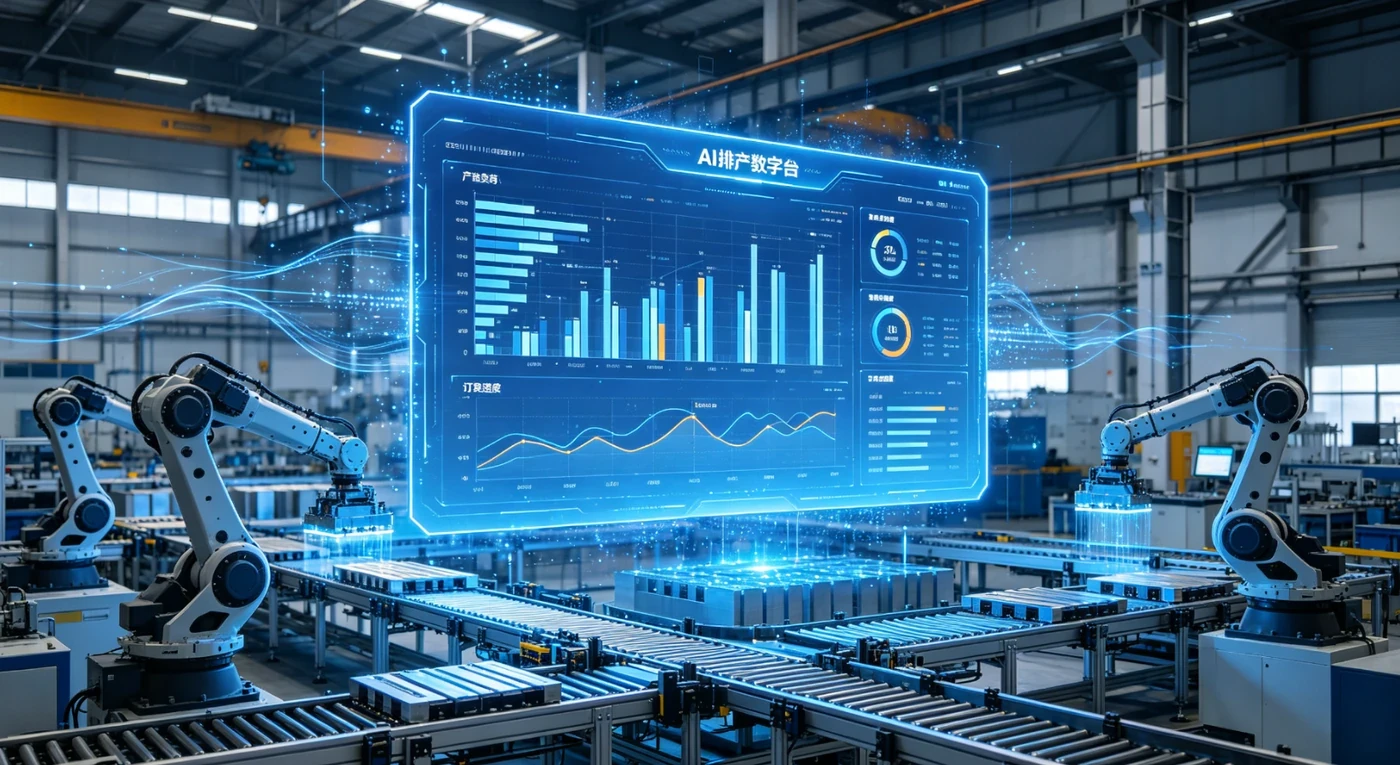
▲ Production scheduling is shifting from experience-based negotiation to data and algorithm-driven optimization.
Why 01 Traditional Scheduling Fails
Production scheduling has become increasingly difficult in recent years—not because planners aren't trying, but because three key variables have changed simultaneously.
The order structure has changed.Shifting from "few SKUs, high volume" to "many SKUs, low volume"—this is the hallmark of discrete manufacturing. Discrete enterprises like machining, electronics, and automotive parts must handle hundreds of orders and thousands of process steps in a single production schedule. Excel formulas can no longer keep up.
Delivery promise changed.Delivery cycle is a core competitive advantage. Customers demand shorter lead times, shifting from "an estimate" to "a guaranteed day."
The perturbation frequency has changed.Rush orders, specification changes, and material delays have become the norm. The Ministry of Industry and Information Technology identified key pain points in manufacturing based on digital transformation case studies: poor responsiveness to frequent order adjustments and urgent rush orders due to a lack of effective priority assessment and scheduling adjustment mechanisms; disconnects between plans and reality caused by equipment availability and capacity load not being updated in real time within the scheduling system.
Scheduling in discrete manufacturing is challenging for four key reasons:Multiple processes and complex process pathsA single part may undergo multiple processes such as turning, milling, grinding, and heat treatment, with the sequence varying by order.Long changeover timeMold, tooling, and fixture changeovers take dozens of minutes to hours; production scheduling must account for the true cost of changeover.Bottleneck equipment coexisting with parallel machinesWhen a bottleneck machine stalls, the entire order chain grinds to a halt.Difficult to assemble materialsThousands of SKUs are required, and production halts if even one is missing. This traps planners in an "impossible triangle": conflicting delivery dates, capacity bottlenecks, and incomplete material kits—all working against each other. Excel can only track material counts; it cannot find the global optimal solution. The result? Reliance on gut feelings, endless calls, and constant firefighting.

▲ From paper forms and manual spreadsheets to data dashboards and automated scheduling
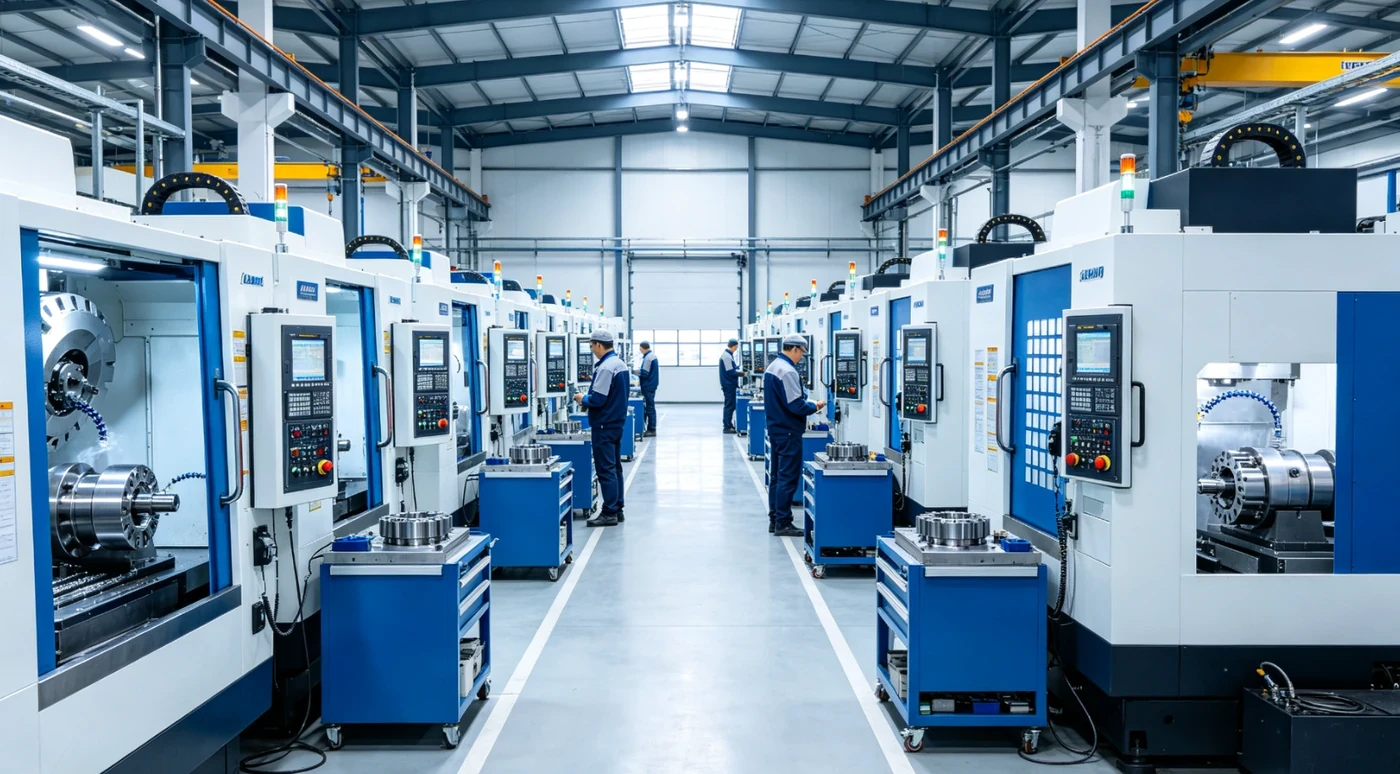
▲ Discrete manufacturing in machining, electronics, and automotive parts faces scheduling complexity far beyond what a single Excel spreadsheet can handle.
What is 02 APS and what it isn't
APS, or Advanced Planning and Scheduling, is a system that optimizes production planning and scheduling.It is a production scheduling system that assigns orders to specific equipment and time slots under constraints of limited devices, molds, materials, and manpower.
However, it is not the same as MRP in ERP. Many companies ask, "Doesn't ERP already have a production planning module?" The key difference lies in the calculation logic.
Dimension | Traditional MRP/ERP Production Scheduling | APS Intelligent Scheduling |
|---|---|---|
Capacity Assumption | Infinite capacity; no equipment load validation | Finite capacity, full resource load modeling |
Calculation logic | BOM reverse engineering, fixed lead time | Multi-constraint joint optimization (capacity, materials, molds, processes, labor, mold changeovers) |
Time granularity | Day, Week | Minutes and hours, broken down by process step and equipment |
Handle rush orders | Re-run MRP | Incremental reordering with controlled scope |
Output results | Purchase Plan, Production Recommendations | Executable, operation-level scheduling and equipment load charts |
Core difference in one sentence:MRP generates plans that are feasible on paper; APS generates plans that are executable on the shop floor.The former assumes infinite capacity, while the latter realistically acknowledges: each machine has only 24 hours per day, changeovers take time, and production cannot start until materials arrive.
03 AI Era: How Has APS Evolved?
Traditional APS systems can automatically schedule production, but they are essentially "calculators": they recalculate when parameters change and provide feasible solutions without learning from historical data. AI-powered APS has brought about three fundamental shifts.
First, shift from "rule-driven" to "strategy optimization."Deep reinforcement learning treats production scheduling as a multi-agent game: when a critical machine fails, the system simulates tens of thousands of rescheduling options in seconds. It automatically generates an optimal new job sequence by balancing multiple objectives, including delivery penalties, changeover costs, and energy consumption.
Second, from "advisor" to "executor."AI agents collect real-time workshop data (equipment status, WIP location, material inventory), understand business constraints (delivery priority, mold sharing limits, process path dependencies), autonomously generate scheduling plans, and push them directly to MES for execution. They automatically adjust schedules when deviations occur.
Third, from "calculator" to "conversational partner."Large models enable planners to adjust production schedules using natural language. The system not only generates schedules but also explains "why" they are made, transforming scheduling from a black box into an interactive dialogue.
Policy signals are also accelerating. In 2026, the Ministry of Industry and Information Technology and seven other departments issued the "Implementation Plan for the 'AI + Manufacturing' Special Action," which explicitly calls for deepening the application of AI technologies in core industrial processes such as production scheduling. By integrating large-scale industrial scheduling models with industrial internet technologies, the plan aims to enable multi-line collaborative scheduling, enhance manufacturing flexibility, and improve response speed.
What does a complete end-to-end solution look like for 04?
An "end-to-end solution" isn't just a collection of features—it's a four-layer architecture with tightly integrated components.
Data Layer (Foundation).Static master data: material codes, BOMs, process routes, equipment capacity, tooling, changeover times, and standard cycle times. Dynamic business data: sales orders, inventory levels, and equipment status. Business constraints: order priorities, expediting rules, and quality standards. Without complete data, the entire system is built on sand.
Model Layer (Engine).Constraint Modeling + Algorithm Engine (Heuristic Optimization, Reinforcement Learning, Large Language Models) + Multi-Objective Optimization (Delivery Dates, Capacity, Cost, Energy Consumption). This layer determines whether the generated schedule is optimal.
Executive Layer (Brain).Demand forecasting, Master Production Scheduling (MPS), detailed shop-floor scheduling (Gantt charts), rescheduling for rush orders, delivery commitment (ATP/CTP), and scenario simulation. This layer answers: "What to schedule, how to schedule, and whether a commitment can be made."
Execute the closed-loop layer (hands and feet).Integrate with ERP, MES, and WMS to close the loop of "Plan → Execute → Improve" through: plan release, execution feedback, rescheduling for deviations, and KPI review.
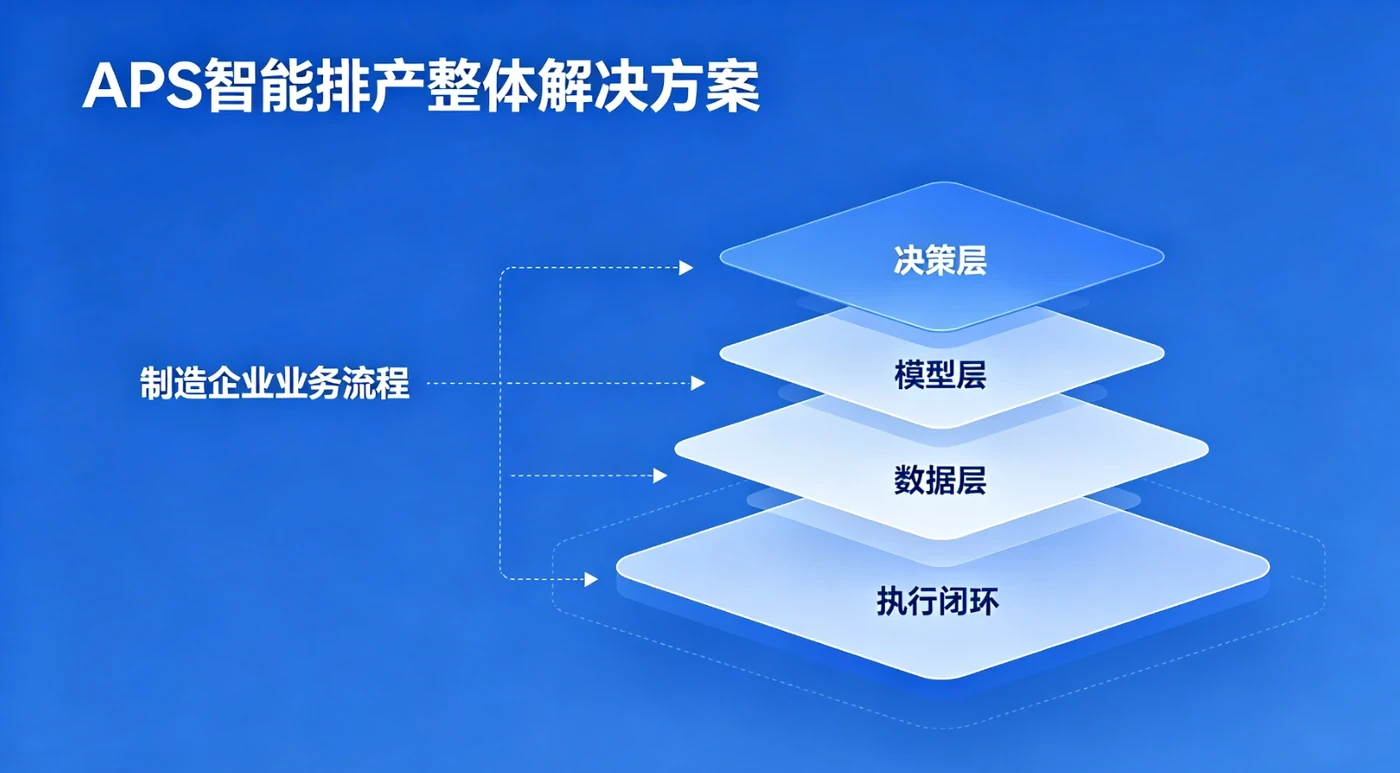
▲ Typical Architecture of the End-to-End APS Solution: Data Layer — Model Layer — Decision Layer — Execution Loop
Summarize in one sentence:APS doesn't just move scheduling from Excel to software. It transforms "planning and execution" from an open loop into a closed loop, shifting from "scheduling possible" to "accurate scheduling, real-time tracking, and rapid adjustments."
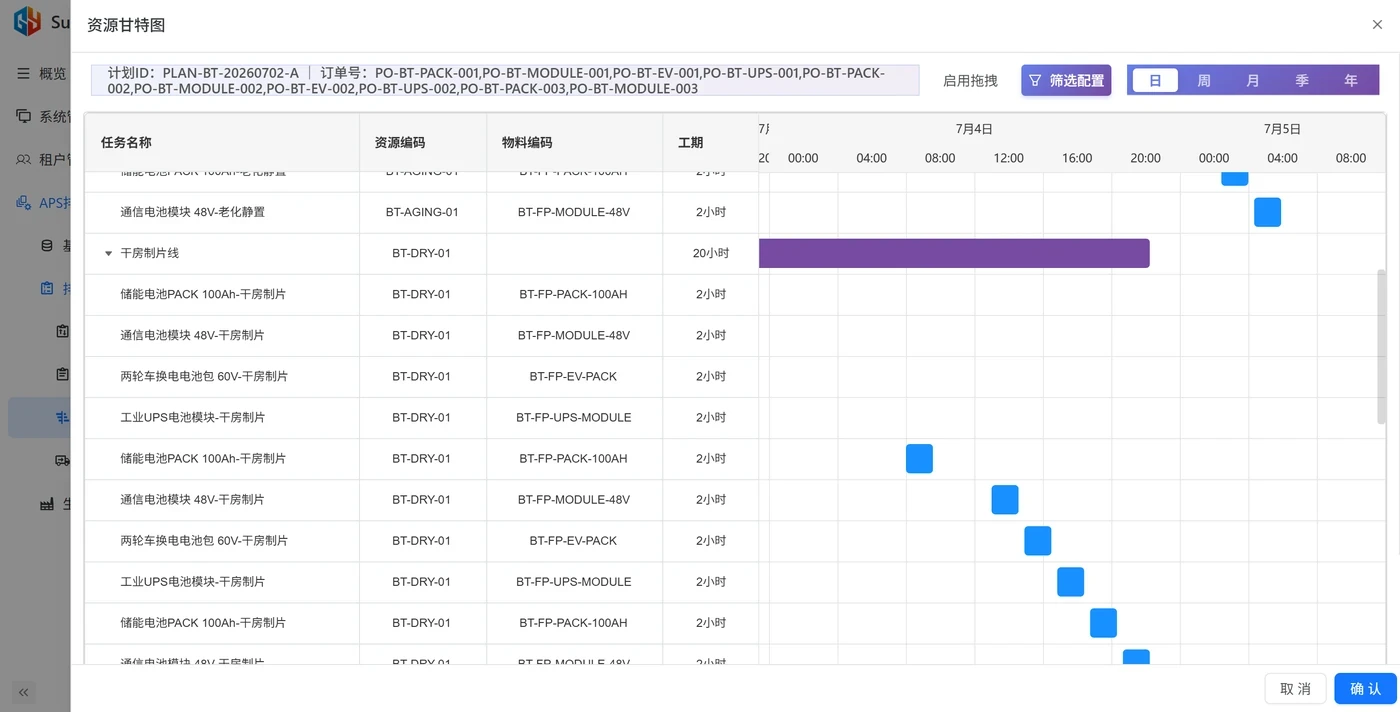
▲ Order rescheduling is a daily reality in discrete manufacturing: a single Gantt chart adjustment involves trade-offs across delivery dates, capacity, and materials.
05 Case Study: Numbers Aren't Just Decoration
How much is production scheduling improvement worth? Consider this verifiable case. According to People's Daily, after Hesteel Tangsteel High-Strength Automotive Steel Co., Ltd. implemented its APS system on the cold rolling line, order-to-delivery time for a hot-rolled coil dropped from 18 days to 12 days; product inventory decreased by 15%; production efficiency increased by 20%; and on-time delivery rate reached 100%.
Publicly disclosed cases in the industry (all listed companies operate in discrete manufacturing; definitions vary, for reference only):
Business Type | Disclosure Effect | Source |
|---|---|---|
A mechanical parts manufacturer (annual revenue: 10 billion yuan) | Production cycle shortened by 20%, planning efficiency improved by 80%, and order fulfillment rate increased by 5 percentage points. | APS Vendor Case Studies |
A manufacturing enterprise | Reduced scheduling time by 93%, decreased delivery delay rate by 68%, and improved capacity utilization by 7.5%. | Industry Technical Articles |
An electronics manufacturing company | Reduced line downtime due to material shortages by 70%; adjusted plan response time from hours to minutes. | APS Vendor Case Studies |
Industry Practices | Oversubscription rate dropped from 40% to 5%, while on-time delivery rate improved from 72% to 96%. | Industry Media |
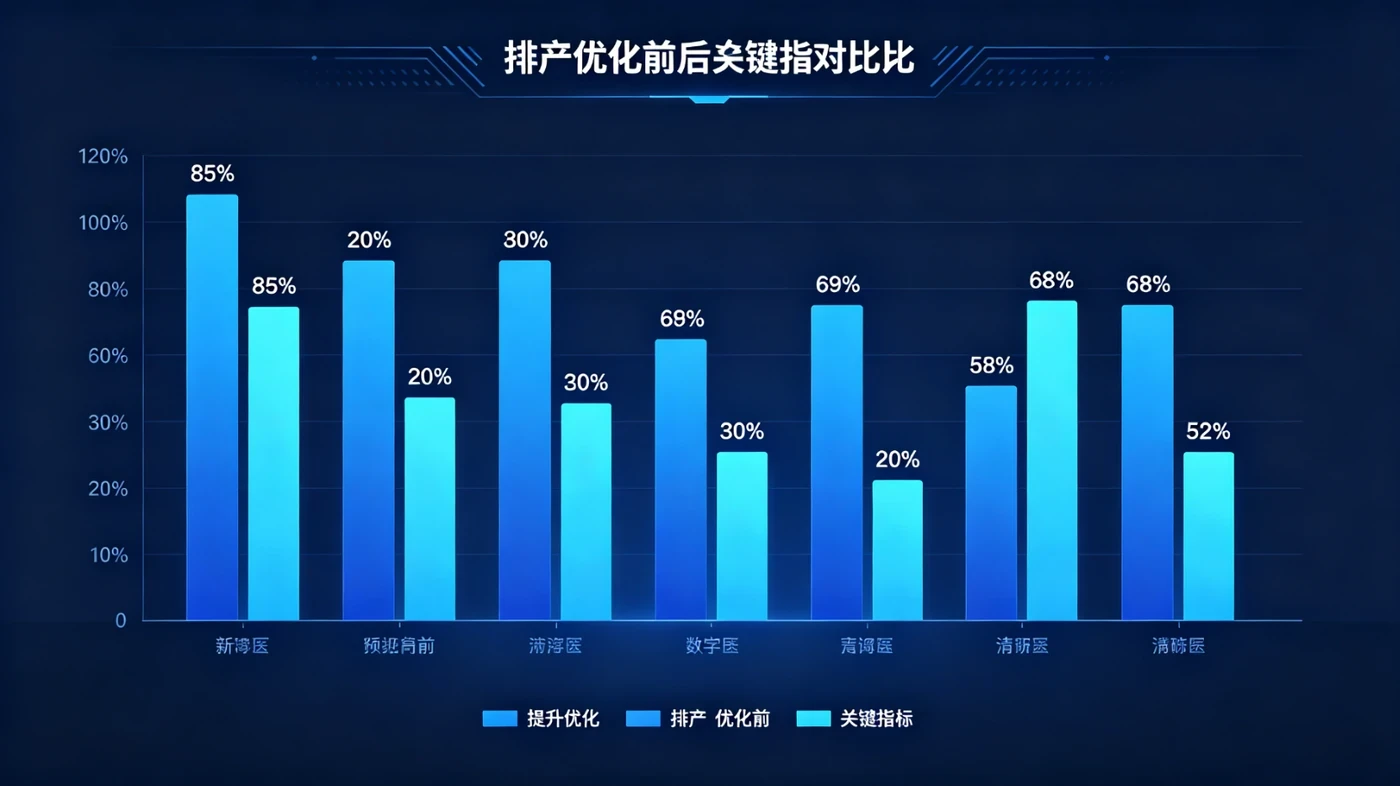
▲ Key metrics comparison before and after production scheduling optimization: improvements extend beyond delivery dates to inventory and equipment efficiency.
Please note: These figures come from different companies and statistical methodologies, so they cannot be directly compared. However, they all point in the same direction—Improvements in production scheduling directly impact delivery dates, inventory levels, and equipment efficiency.
06 3 Common Myths to Rule Out First
Myth 1: "Buy the software, install it, and you're good to go."Data is the foundation. In production scheduling, "garbage in, garbage out" is the cruelest reality: inaccurate data leads solvers to generate plans that look precise but are impossible to execute. Planter trust collapses on day one. Foundational data—BOMs, routings, standard times, and changeover durations—determines success or failure more than algorithms do.
Misconception 2: "With APS, planners are no longer needed."Quite the opposite. Order prioritization, customer communication, and exception handling still require human judgment. APS frees planners from editing spreadsheets, making calls, and putting out fires—so they can focus on real decision-making.
Myth 3: "The more expensive and feature-rich the system, the better."SMBs benefit from integrated lightweight APS; mid-sized discrete manufacturers should choose standalone commercial APS; only large multi-plant groups require advanced professional APS. Blindly pursuing "comprehensive" solutions leaves 90% of features unused and necessitates a dedicated IT maintenance team.
How to get started with 07 enterprise implementation
Instead of asking "Should I take the APS?", just complete these four steps first:
Step 1: Assess business complexity.Number of product variants, number of operations, changeover time, rush order frequency, and delivery pressure. If your business is simple enough, APS may not be a priority; the higher the complexity, the greater the return.
Step 2: Inventory data foundation.Is the BOM complete? Are labor hours accurate? Can equipment status be retrieved in real time? If data is unclear, fix it first before discussing algorithms.
Step 3: Select pilot scenarios.Start with the bottleneck that's most obvious and offers measurable ROI. Iterate quickly, let real results speak.
Step 4: Organize supporting measures.Redefine the planner's role by establishing a "Plan-Execute-Review" mechanism. Systems are just tools; processes ensure lasting impact.
APS in the AI era isn't about installing a "smarter scheduling tool" for factories. It's about shifting production decisions from experience-driven to data- and algorithm-driven, then returning human judgment to its proper role: handling exceptions, making trade-offs, and focusing on customers.
The real questions aren't "Should we implement APS?" but rather: "Is our data ready? Are we prepared to change our production scheduling approach?" When these are addressed, the true value of the system becomes clear.
Related Solutions
Enterprise AI Transformation + FDE Advisory Coaching
Provides end-to-end AI-driven digital transformation top-level planning and full-cycle implementation support for enterprises.
When SRM Meets AI Agents: Supply Chain Management is Evolving
Has your enterprise implemented SRM? Where are you stuck—data, rules, or organization?
AI Agents in the Workshop: A MOM Manufacturing Operations Solution Built on WorkBuddy
AI Agent + MOM: Bridging the Gap from "Chatting" to "Getting Things Done" with a Robust Foundation.